Joe Archondis
July 4, 2026 · 9 min read
Business AI Automation
Why Multi-Location Businesses Need AI Automation Before a Second Manager
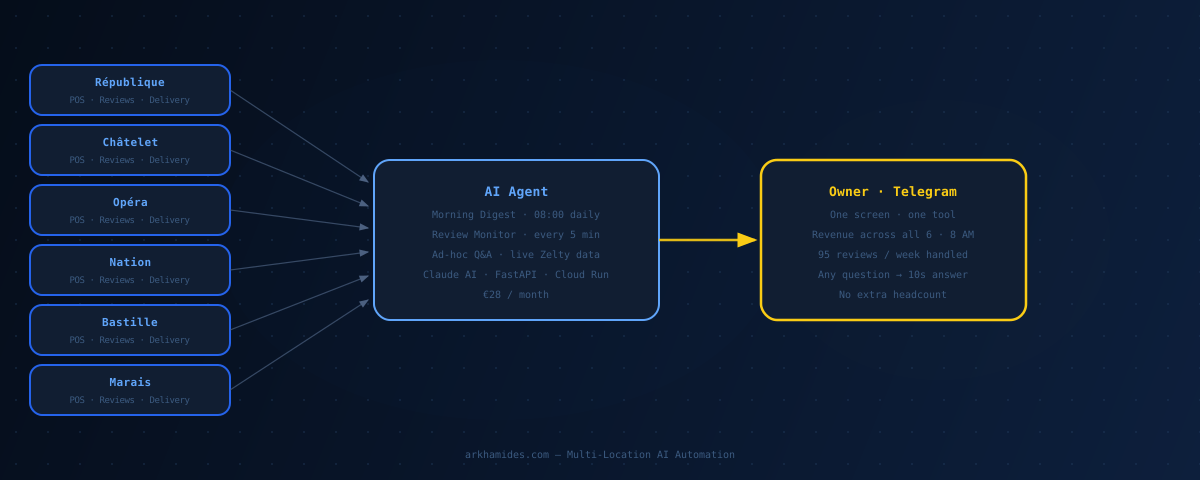
The Shawar'Mama owner ran 3 Paris locations with one operations manager and a constant stream of phone calls. When he expanded to 6, the obvious answer was a second manager at €3,500/month. Instead, we spent 3 weeks building an AI agent. It costs €28/month in infrastructure. It sends him a revenue breakdown across all 6 locations every morning before 8 AM, catches every negative review within 5 minutes, and answers any operational question in under 10 seconds.
This isn't about replacing people. It's about identifying the 40% of a manager's day that is pure information retrieval — and automating that before you hire another human to do the same thing.
Why Multi-Location Operations Break at Scale
One location is a people problem. You hire good staff, train them, and stay on top of service quality in person. Three locations is still mostly a people problem, with coordination overhead added. You're splitting time between sites, relying on managers to escalate issues, staying in contact by phone.
Six locations is a data problem. You no longer have personal visibility into each site. You're entirely dependent on information flowing to you. Revenue figures, customer complaints, inventory gaps, staff performance — all of it exists in 3 to 5 disconnected systems. The moment you own more locations than you can physically visit in a day, the bottleneck changes. It's no longer "do I have good people?" It's "do I have good information, fast enough?"
Most multi-location businesses have a people solution to a data problem. They hire another manager. That manager spends a large portion of their time being a human conduit between data systems and the owner. It works. It's also expensive, slow, and hard to scale.
What a Manager Actually Spends Time On
Before building the Shawar'Mama system, I spent time understanding exactly what the ops manager did each day. The breakdown across a typical morning:
- ~45 minutes: Pull yesterday's revenue from Zelty across all locations. Format it. Send summary to the owner.
- ~30 minutes: Check Google Reviews across all 6 Google Business profiles. Flag negatives. Draft responses or forward to owner.
- ~45 minutes: Answer the owner's performance questions throughout the morning. "How did Saturday go?" "Which location had the lowest ticket?" "Is Marais trending down?"
- Remaining time: Location visits, staff management, supplier calls, strategic decisions.
The first two hours — reporting, review monitoring, answering data questions — are information retrieval. Structured, repetitive, and entirely driven by data that already exists in APIs. That's the automation target. The last category — staff management, suppliers, strategy — still requires a person.
The Shawar'Mama owner wasn't looking for a robot manager. He was looking to stop paying human rates for tasks a machine handles in seconds.
The Three Systems That Replace the Reporting Layer
The AI agent we built handles three specific jobs. Each maps directly to something the manager was doing manually.
Morning Digest
Every day at 8:00 AM, the agent fetches the previous day's sales from Zelty across all 6 locations, computes revenue, covers, average ticket, and week-over-week deltas, and sends a formatted Telegram message to the owner. Directional signals (✅ up, ⚠️ slight decline, 🔴 down more than 10%) show which locations need attention. An automatic flag fires if any location has declined for three consecutive days.
The manager used to spend 45 minutes building this manually every morning. The agent does it in 12 seconds. Accuracy is higher because there's no manual data entry. The format is consistent because it doesn't depend on whoever happened to be working that morning.
Review Monitoring
Every 5 minutes, the system polls Google My Business across all 6 locations. When a review with 3 stars or fewer appears, it reads the review, checks the owner's full response history, and drafts a reply matched to the language (French or English) and tone of how the owner has responded before. The owner gets a Telegram message with the review text, the draft response, and three buttons: Post, Edit, or Reject.
Before this system, negative reviews sometimes sat unanswered for 2 to 3 days. The manager was checking manually, maybe twice a day. Now 95 reviews per week are handled, every one responded to within 5 minutes of appearing. The owner spends 10 to 15 seconds per review instead of 5 to 10 minutes.
Ad-Hoc Q&A
The owner types any operational question in Telegram and gets a live answer from Zelty within 10 seconds. "What sold best at Marais last Saturday?" "How does this month compare to last June?" "Which location had the highest average ticket this week?" The agent decides what to fetch, queries the POS in real time, and returns a clean answer. Conversation history persists, so follow-up questions work naturally.
These questions used to go to the manager by phone or message. The manager had to log into Zelty, pull the data, format it, and reply — usually 10 to 30 minutes later. Now it's 10 seconds, available at any hour, regardless of whether the manager is on a location visit or off for the day.
AI vs. Headcount: An Honest Comparison
The right framing is not "replace managers with AI." It's "identify which part of the manager's job is pure information retrieval, and automate that layer." What AI handles well and what it doesn't:
| AI handles well | Still requires a person |
|---|---|
| Structured data retrieval across locations | Staff performance management |
| Pattern detection (location X is down 12%, 3 days) | Supplier negotiations and relationship work |
| Daily reporting at consistent quality | Creative decisions (menu, pricing, events) |
| Templated communication at scale (95 reviews/week) | Handling staff conflicts in person |
| Answering fact-based questions from live data | Strategic planning and location expansion decisions |
The Shawar'Mama owner kept his operations manager. That manager shifted from spending half their day on data retrieval to spending nearly all of it on actual management. Same headcount, 6 locations instead of 3.
The Cost Comparison
| Second Manager | AI Automation Layer | |
|---|---|---|
| Monthly cost | €3,000–4,500 | €23–35 |
| Morning reporting | 45 min/day | 12 seconds |
| Review monitoring | Manual, 1–2× per day | Every 5 min, 24/7 |
| Data question turnaround | 10 min to 1 hour | 8–12 seconds |
| New location added | Renegotiate scope and pay | One config line, no extra cost |
The comparison isn't fair in one direction: the agent doesn't replace a manager for everything. But for the specific reporting and information layer, it outperforms a person on every metric except judgment. And the build cost is 2 to 3 weeks of engineering time, recovered in the first month of not hiring a second manager.
When to Build This
The inflection point is 3 to 4 locations. At that size, direct daily visibility into each site is gone, morning reporting takes real time, and information flow becomes the main bottleneck. A few specific signals that the automation layer is overdue:
- You're asking staff or managers questions that should be answered by data
- Morning reporting takes more than 30 minutes to compile
- Negative reviews sit unanswered for more than 24 hours
- You're considering hiring a manager whose primary job would be compiling reports and forwarding information
If any of those are true, you have an automation opportunity before a headcount decision. The infrastructure costs €23 to €35 per month. Build time is 2 to 3 weeks. And unlike a manager, the system covers one new location with a single config change — no renegotiation, no onboarding, no ramp-up time.
Three months after going live, the Shawar'Mama owner had the same size management team handling double the number of locations. The constraint wasn't people. It was always information.
Frequently Asked Questions
At what number of locations does multi-location business automation make sense?
The inflection point is usually 3 to 4 locations. At that size you lose direct daily visibility, morning reporting becomes a real time cost, and information arrives too slowly. The clearest signal: you're considering hiring a manager whose primary job would be compiling and forwarding data. That's the automation target, not a headcount decision.
Does AI automation replace the operations manager?
No. The automation handles information retrieval, daily reporting, and templated responses — roughly 40% of what a typical operations manager spends their time on. Everything requiring judgment — staff management, supplier negotiations, location visits, strategic decisions — still requires a person. The result is that your existing manager covers more locations, not that you fire them.
What data sources does a multi-location AI agent connect to?
For the Shawar'Mama system: Zelty POS for revenue and sales data, Google My Business for reviews across all 6 locations. The architecture works with any REST API — adding a new source means writing one async fetch function. Common additions: delivery platforms like Deliverect or Uber Eats, inventory management systems, and staff scheduling tools.
How long does it take to build a multi-location automation system?
A single-source implementation takes 2 to 3 weeks. Multi-source (POS plus reviews plus delivery) typically runs 3 to 5 weeks. The bulk of the time is data integrations, not the AI or Telegram layers — those are straightforward. Budget an extra week for digest formatting: it usually takes 2 to 3 rounds before the format is one the owner actually reads every day.
What does it cost to run this per month?
Infrastructure for a 6-location setup runs €23 to €35 per month: Cloud Run always-warm instance around €5, Cloud SQL PostgreSQL around €15, and Claude AI API calls for digests and review responses around €3 to €15 depending on review volume. Compare that to a second manager at €3,000 to €4,500 per month — and the automation covers all locations with a single config change when you open a seventh.
Working on something similar?
I build AI agents and low-latency systems. If you're trying to solve a version of this, let's talk.
Get in touchAuthor: Joe Archondis — AI systems engineer and HFT infrastructure builder.
Last updated: 2026-07-04