Joe Archondis
July 10, 2026 · 10 min read
Fintech & Algo Trading
Market Microstructure Explained: Slippage, Spread, and Order Flow
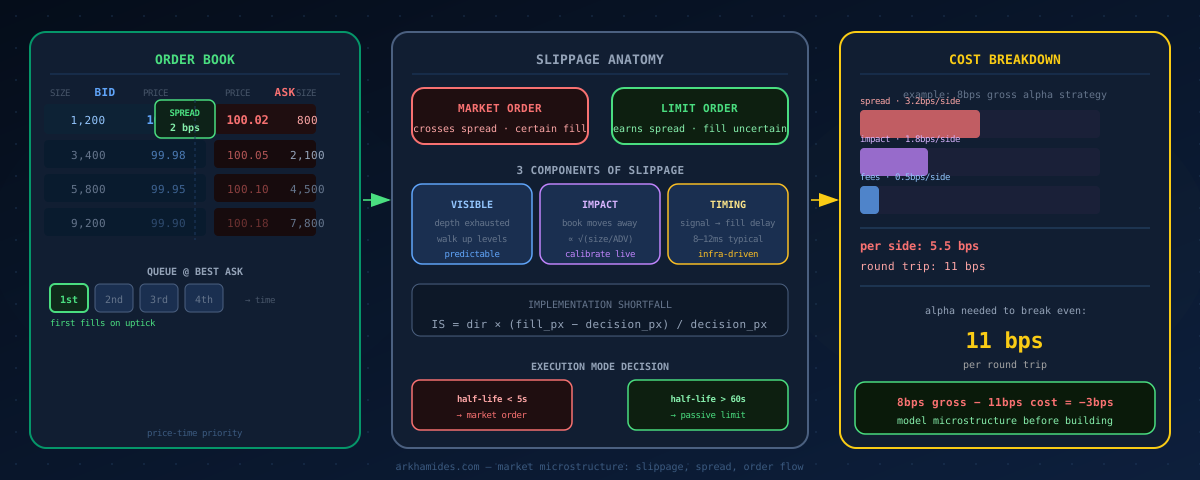
At Enigma Securities, we ran a market-neutral equity strategy that posted 1.4 Sharpe in backtesting. Live, it was barely profitable. The signal was real. The model was clean. The problem was microstructure: we were paying 3.2 basis points per side in visible spread, plus roughly 1.8bps in price impact from our own order flow. At those costs, you need 10bps of daily alpha just to break even. Most strategies don't have that margin.
Market microstructure is the mechanics of how trades actually happen — order books, queue priority, how spreads form and change, and where money gets lost between a decision and a fill. Every algo trader knows the terms. Fewer understand the numbers well enough to catch the problem before it shows up in live P&L.
The Bid-Ask Spread Is Not Just a Fee
If you buy at the ask and immediately sell at the bid, you lose the spread. That much is obvious. What's less obvious is why the spread is what it is, and why it changes constantly.
Market makers post quotes on both sides of the book and collect the spread from uninformed traders. They lose to informed traders, meaning people who know something about where the price is going. The spread is their compensation for bearing that adverse selection risk. Wide spread signals high perceived risk. Narrow spread signals competition among market makers and confidence that incoming flow is mostly uninformed.
In S&P 500 futures during regular hours, the spread is typically 0.25 ticks, the minimum. A small-cap equity on a slow afternoon might be 5-10 ticks wide. That difference tells you how much adverse selection risk the market makers are pricing in, and how many competing market makers are fighting over the flow.
The practical split: a trend-following strategy that takes liquidity pays the full spread on every trade. A mean-reversion strategy that posts limit orders earns the spread, but only when orders fill, which requires adverse price movement first. You pay the spread either way. The question is whether you're paying it directly or absorbing it via fill uncertainty.
Slippage Has Three Separate Components
People use "slippage" to mean "the price I got versus the price I wanted." That conflation hides three distinct costs with different causes and different fixes.
Visible slippage happens when your order size exceeds the depth available at the best price level. You place a market order for 10,000 shares. The best offer has 2,000 shares. You walk up through four price levels to fill the remaining 8,000. That walk-up is visible — you can see it in the order book before you trade. It's also predictable, which means it's the easiest component to model.
Market impact is the price change caused by your own trading activity. Other algorithms detect your order flow and adjust their quotes before you finish filling. A 100,000-share order in a stock averaging 2 million shares daily doesn't move through a static book. The book moves away from you as you trade. Market impact scales roughly with the square root of your participation rate: doubling your order size in a given window increases impact by about 40%, not 100%.
Timing slippage is the gap between when you decide to trade and when your order arrives at the exchange. At Enigma, our tick-to-order time ran at 8-12 milliseconds. During those 12ms, the market moves. If you're buying, the price usually moves higher before you arrive — that's adverse selection from your own latency. In HFT, this component can be the largest of the three.
For any quantitative strategy, model all three separately. Visible slippage comes from order book data. Market impact requires calibration against actual fills. Timing slippage is a direct measure of your infrastructure.
Order Flow Toxicity
Order flow toxicity is the degree to which incoming order flow comes from informed rather than uninformed traders. It matters because market makers adjust their behavior based on it — and those adjustments cost you.
When toxicity is high, market makers widen spreads or withdraw quotes entirely. They've detected something — aggressive one-sided volume, unusual flow patterns, elevated cancellation rates — and they'd rather not be on the other side of a trade that's about to move against them. VPIN (Volume-Synchronized Probability of Informed Trading) is one proxy measure: it estimates the fraction of volume that's informed based on buy-sell imbalance.
The behavioral signals to watch:
- Aggressive one-sided volume often precedes directional moves
- Widening spread with thinning depth means market makers are backing off
- Order cancellation rates above 80% are normal in HFT; sudden drops can signal that informed participants are actually trading, not just probing
- A sustained imbalance between order flow on the bid versus ask side is a directional signal in itself
At Enigma, we tracked imbalance metrics on our top instruments in real time. When flow looked toxic, we widened our own quotes. When it looked uninformed, we narrowed them and increased size. The adjustment wasn't enormous — a few basis points — but at HFT throughput, small adjustments to fill rate and adverse selection add up.
Queue Position and the Cost of Waiting
Most exchanges use price-time priority: orders at the same price fill in the order they arrived. First in queue fills first. Last in queue fills last, or not at all if volume doesn't clear the entire level.
Queue position has asymmetric value that's easy to misunderstand. Early position at the best offer means you fill when buyers arrive — which is when the price is moving in your favor. Late position means you often don't fill. That sounds bad. But late position also means you avoid adverse selection: you miss fills when someone is aggressively buying because they expect an upward move. Missing that trade is actually a positive expected value outcome for a short-biased or neutral strategy.
Several mechanics follow from this.
Modifying a limit order to improve the price almost always means losing your queue position. Cancel the order and replace it at a better price, and you move to the back of the queue at the new level. In competitive market-making, queue management is a substantial part of the strategy logic — not just signal generation.
In maker-taker fee models, resting limit orders earn a rebate and market orders pay a fee. A 0.2bps maker rebate versus a 0.3bps taker fee creates a 0.5bps per-side edge for passive execution. On a high-turnover strategy running thousands of trades per day, that compounds into a meaningful performance driver.
How Microstructure Shapes Strategy Design
Microstructure isn't just background knowledge. It determines which strategies are viable at which scale.
The central execution decision is passive versus aggressive. The right choice depends on how fast your signal decays and what the spread costs you to cross.
def choose_execution_mode(alpha_half_life_seconds, spread_bps, urgency):
    """
    Rough framework for passive vs. aggressive execution choice.
    alpha_half_life_seconds: how fast the signal decays
    spread_bps: current bid-ask spread in basis points
    urgency: 0.0 (flexible) to 1.0 (must execute now)
    """
    if urgency > 0.8:
        return "market_order"          # pay spread, get guaranteed fill

    if alpha_half_life_seconds < 5:
        return "market_order"          # signal decays before passive fill likely

    if spread_bps > 3.0 and alpha_half_life_seconds > 60:
        return "passive_limit"         # spread too expensive, signal patient enough

    if alpha_half_life_seconds < 30 and spread_bps < 1.5:
        return "aggressive_limit"      # tight spread, moderate urgency

    return "passive_limit"             # default: earn the spread
Alpha half-life is the key variable. A mean reversion signal with a 10-minute half-life can post limit orders and wait. A momentum signal with a 3-second half-life cannot. By the time a passive limit order fills, the edge is gone. Crossing the spread is cheaper than missing the trade.
For larger orders, execution algorithms distribute the impact over time:
| Order Type | Fill Certainty | Spread Cost | Market Impact | Best For |
|---|---|---|---|---|
| Market order | Certain | Full spread paid | High | Urgent; signal half-life < 5s |
| Aggressive limit | High | Partial spread paid | Medium | Moderate urgency; 10–30s half-life |
| Passive limit at touch | Low–medium | Spread earned | Low | Patient signals; mean reversion |
| TWAP | High (over window) | Variable | Reduced vs. block | Large orders; price-sensitive |
| VWAP | High vs. benchmark | Variable | Reduced vs. block | Benchmark tracking |
Measuring Your Actual Execution Costs
The only way to know your real microstructure costs is to measure them from production fills. Theory gets you in the right order of magnitude. Measurement tells you where you're actually bleeding.
Implementation shortfall (IS) is the standard framework. It compares your strategy's theoretical returns calculated at decision prices versus actual returns at fill prices. The gap is total execution cost: spread, slippage, timing, and market impact combined.
def implementation_shortfall(decision_price, fill_price, direction):
    """
    Implementation shortfall in basis points.
    direction: +1 for buy, -1 for sell.
    Positive = you paid more than the decision price (cost).
    """
    shortfall = direction * (fill_price - decision_price) / decision_price
    return shortfall * 10_000  # basis points

def realized_spread(fill_price, midpoint_n_seconds_later, direction):
    """
    Realized spread: spread you actually captured (positive) or paid (negative).
    Persistent negative realized spread = adverse selection problem.
    """
    return direction * (fill_price - midpoint_n_seconds_later) / midpoint_n_seconds_later * 10_000
Run both calculations on every fill. Segment by instrument, time of day, and volatility regime. If your realized spread is consistently negative — you're consistently buying before the price moves further against you — that's an adverse selection problem. Either your order flow is predictable and other algos are front-running you, or your execution timing is systematically bad.
The strategy that fixed itself for us at Enigma wasn't a new signal. It was switching from market orders to aggressive limits on our less-urgent fills, cutting 1.4bps per side and pushing the strategy back into profitable territory.
The Number to Start With
Before you run a single backtest on a new strategy, calculate the minimum alpha required just to survive transaction costs. For any strategy with meaningful turnover, this number is larger than it looks.
Take a liquid equity strategy trading 20 times per day. Each round trip costs 5bps all-in (3.2bps spread, 1.3bps market impact, 0.5bps commission). That's 100bps per day in costs. You need 100bps daily gross alpha before you see any net return. Most signals don't generate that. The ones that do tend to be high-frequency by nature — meaning they work at scale and in favorable microstructure conditions, and fail when spreads widen or liquidity thins.
Knowing this before you build is what separates strategies you can deploy from exercises that look great in a notebook and disappear on contact with live markets.
Frequently Asked Questions
What is market microstructure and why does it matter for algo traders?
Market microstructure is the study of how trades actually get executed: bid-ask spreads, order book mechanics, queue priority, and how prices form at the transaction level. For algo traders, it matters because microstructure costs directly subtract from strategy returns. A strategy with strong alpha can still be unprofitable if spread, slippage, and market impact together exceed the expected return per trade. Modeling these costs before backtesting is how you avoid strategies that look great on paper but lose money live.
What is the difference between slippage and market impact?
Slippage is the difference between your expected execution price and your actual fill price, across all causes: order book depth, timing delays, and price movement during execution. Market impact is specifically the price change caused by your own trading activity. When a large order hits the market, other algorithms detect the flow and adjust their quotes before you finish filling. Market impact scales roughly with the square root of participation rate — doubling your order size in a given window increases impact by about 40%, not 100%.
How do I reduce slippage in my algorithmic trading strategy?
The most effective lever is execution mode. Passive limit orders earn the spread instead of paying it, but introduce fill uncertainty. For liquid instruments with patient signals, posting limit orders at or slightly inside the spread reduces slippage significantly. For urgent or short-half-life signals, TWAP or VWAP algorithms reduce market impact compared to block execution. The most important step is measuring your actual implementation shortfall from production fills — that number tells you where the cost is coming from, which determines what to fix.
What is order flow toxicity?
Order flow toxicity refers to the degree to which incoming order flow comes from informed traders rather than uninformed ones. Informed flow is toxic for market makers because they are trading against someone who knows something they do not. High toxicity shows up as aggressive one-sided volume, widening spreads, and elevated order cancellation rates as market makers withdraw. VPIN (Volume-Synchronized Probability of Informed Trading) is one proxy measure. Practically, high-toxicity periods are signals to widen quotes or reduce liquidity provision.
Does market microstructure differ between equity, futures, and crypto markets?
Significantly. Equity markets are fragmented across many venues with payment for order flow and varying maker-taker fee models. Futures markets are typically more centralized with single order books, which simplifies microstructure analysis considerably. Crypto markets vary by exchange — maker-taker fees, flat fees, and hybrid models all exist — and liquidity fragmentation creates arbitrage opportunities not present in traditional markets. On-chain DeFi microstructure is entirely different: MEV (maximal extractable value) means validators can front-run transactions at the protocol level itself.
Working on something similar?
I build AI agents and low-latency systems. If you're trying to solve a version of this, let's talk.
Get in touchAuthor: Joe Archondis — AI systems engineer and HFT infrastructure builder.
Last updated: 2026-07-10